University-Level Goals
Guiding Commitments at the University of Maryland
At the University of Maryland, sustainability means caring for people, place, and planet, for today and future generations. Our university sustainability goals are aligned with the University of Maryland Strategic Plan, which guides the university’s teaching, research, and service to the community.
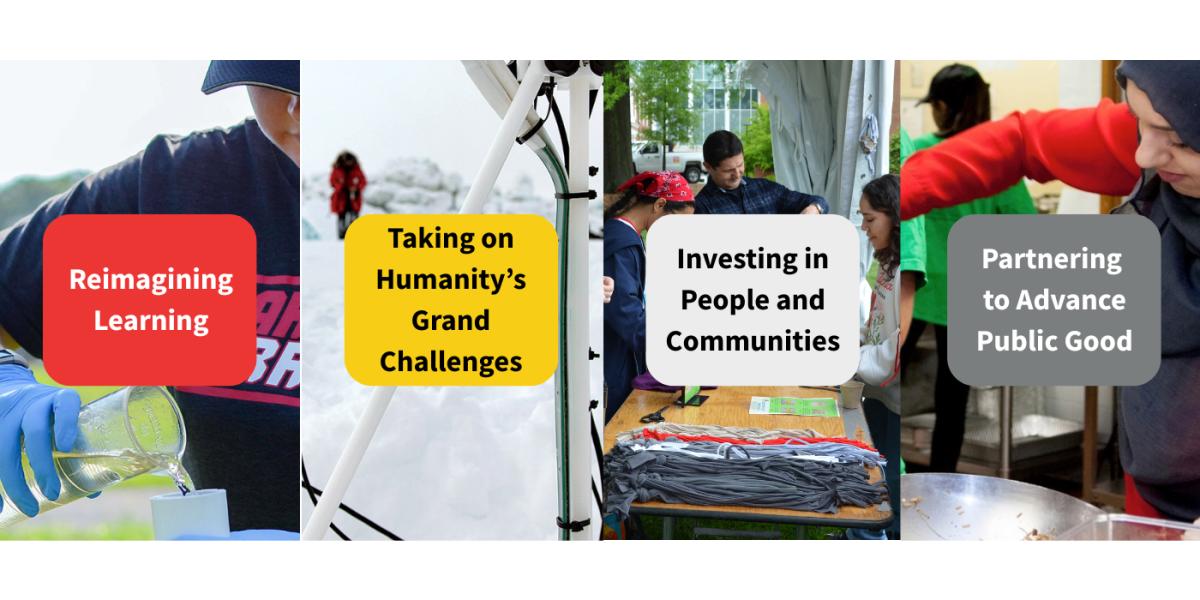
The Strategic Plan is organized around four pillars: We reimagine learning, we take on humanity's grand challenges, we invest in people and communities, and we partner to advance the public good. Together, these pillars shape how students, faculty, and staff advance sustainability through academics, research, campus life, and community partnerships.
Read more about how these university pillars connect to sustainability below.
We Reimagine Learning
UMD prepares students to understand environmental and social challenges through interdisciplinary education. One of the university’s most popular undergraduate offerings is the Sustainability Studies minor, which equips students from all majors with foundational knowledge and practical skills to apply sustainability principles in real-world settings.
Across campus disciplines, sustainability is embedded in coursework, experiential learning, and academic programs that aim to connect classroom learning to local and global challenges. Academic units with integrated sustainability teachings include many of the university’s 12 colleges and schools and the University of Maryland Center for Environmental Science.
We Take on Humanity’s Grand Challenges
Sustainability is a central research focus at UMD, with 53 of 58 research departments engaged in sustainability-related work. Faculty and students collaborate across disciplines to address challenges such as climate change, energy transitions, public health, and environmental risk.
Key research centers include the Center for Global Sustainability, Earth System Science Interdisciplinary Center, Center for Health Risk and Communication, and the Maryland Energy Innovation Institute. The Grand Challenges Grant Program supports innovative research projects that address emerging societal and environmental needs.
We Invest in People and Communities
Sustainability at UMD is rooted in the well-being, equity, and inclusion of its people. By supporting a healthy, safe, and engaged campus environment, the university enables students, faculty, and staff to participate in sustainability efforts on campus and beyond.
Programs and resources that support people-centered sustainability include the Office of Multicultural Involvement & Community Advocacy, LGBTQ+ Equity Center, Nyumburu Cultural Center, and campus funds that provide direct support to students and employees. Initiatives such as the Campus Pantry and Terp to Terp Campus ReUse Store also connect social well-being with environmental responsibility.
We Partner to Advance the Public Good
UMD works beyond campus boundaries to support sustainable and equitable communities. Through the Center for Community Engagement, the university builds partnerships that create meaningful long-term change in College Park, Prince George’s County, the state of Maryland, and beyond.
These partnerships address issues such as food access, environmental restoration, education, and climate resilience. Programs like Engineers Without Borders, Food Recovery Network, Watershed Protection and Restoration Program, and the Maryland Mentor Corps demonstrate how strong relationships amplify the collective ability to tackle complex, interdisciplinary issues.
How These Goals Guide University Action
Beyond the 2014–2024 University of Maryland Strategic Plan, the university’s Sustainability Council evaluates university, state, and global goals, identifies gaps, and recommends opportunities for UMD to lead. The Council maintains six guiding sustainability goals that inform planning and funding decisions across campus operations. It is chaired by the VP of Administration and Chief Administrative Officer and consists of representatives of each member of the President’s Cabinet, staff members, faculty, and an undergraduate and graduate student representative.