
Article by Vivian Maneval '27
For many, the path toward sustainability begins with a question: What more can I do? For some faculty and staff at the University of Maryland, this question has been asked and answered in creative ways through the pursuit of the Sustainability Badge. More than just a recognition, the badge shows a commitment to living and working with a greater awareness of one’s personal impact.
The Sustainability Badge offers staff and faculty a tangible way to engage in campus sustainability efforts in their workplace and at home. Through the program, participants are encouraged to adopt everyday practices that reduce their environmental impact. For these individuals, whether sustainability is already a large priority or simply a new exploration, the Sustainability Badge provides an accessible entry point. Participation is open to all staff and faculty.
How does it work? Participants select eight actions from a curated list of sustainable activities and adopt them into their professional and personal lives. These include sharing sustainable resources with colleagues, reducing data storage by clearing out computer files, commuting smart, and properly sorting waste. After completing their actions mindfully, they submit their progress to the Office of Sustainability and earn their Sustainability Badge.
Below, meet four sustainable Terps who have earned the badge, and learn how their commitments have continued to shape their habits and impact beyond the program.

Tyrese Fenty, Program Coordinator of Learning and Development at the Do Good Institute
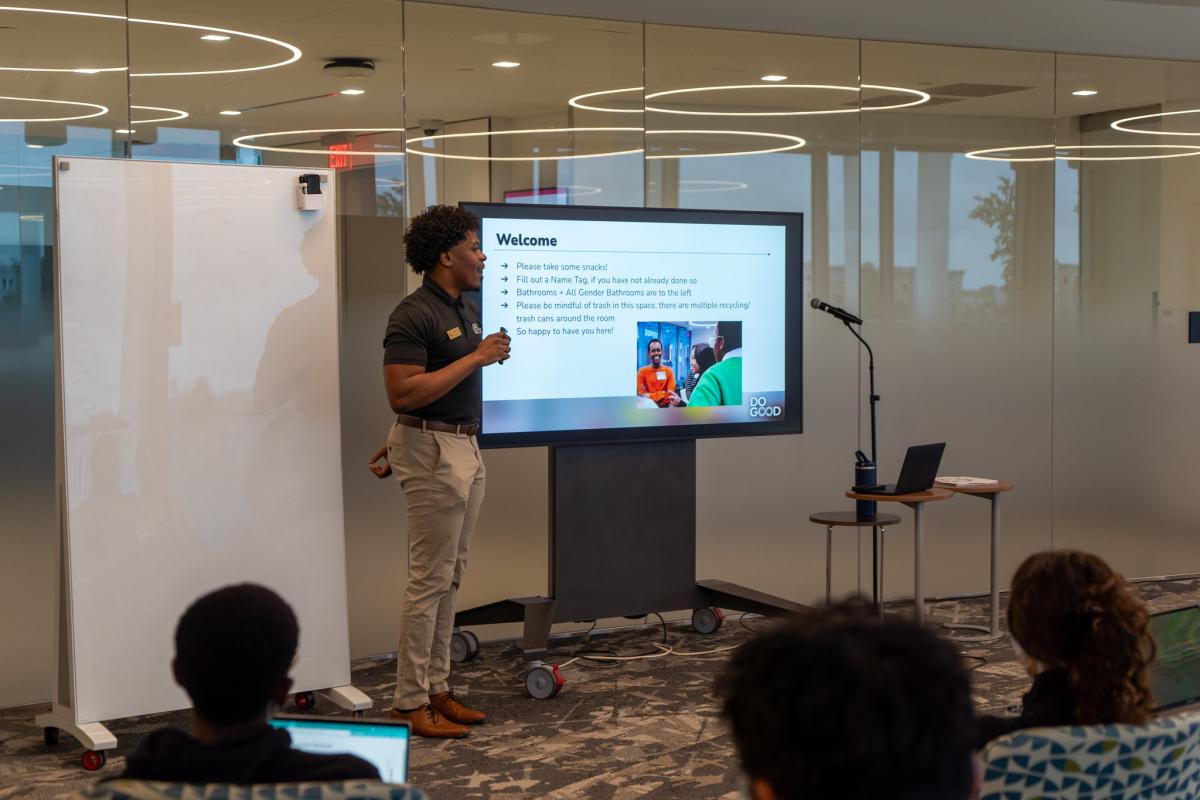
For Tyrese Fenty, the question of “What more can I do?” wasn’t new; it was already embedded in his daily routine. Since graduate school, sustainability has shaped how he moves through his life, from composting food scraps to unplugging devices not in use. The Sustainability Badge offered him something different. It was a way to turn these habits into collective action. Aligned with the “Create Community” section of the checklist, Tyrese encouraged his fellow staff members to earn their badge. Rather than simply checking off list items, Tyrese used the badge as an opportunity to refine his choices throughout his workplace, the Do Good Institute. Small shifts like using reusable utensils and reducing reliance on single-use containers are now commonplace in the office, reflecting a significant change in energy use and team dynamics, with sustainability becoming a shared value.
In his own words, Tyrese views the Sustainability Badge as a stamp of approval, showing the commitment to the mission of the Do Good Institute and inviting others to participate. He estimates that most of his colleagues also engage in sustainability practices daily, reinforcing the collective commitment.
 Dr. Sylvette La Touche-Howard, Assistant Dean, Office of Public Health Health Practice & Community Engagement; Associate Clinical Professor
Dr. La Touche-Howard isn’t a stranger to sustainability, which she describes as “near and dear” to her. Ingrained in lessons from her childhood about caring for and reusing what you have, her approach is practical and personal. The Sustainability Badge renewed these ideas with a new urgency and purpose, encouraging her to share the values with others.
Earning the badge influenced Dr. La Touche-Howard to rethink everyday practices in her office, from reducing catering waste to eliminating unnecessary paper agendas. What may seem like small adjustments quickly became intentional decisions for the whole office. Now, she challenges her office’s students to be more sustainable as well, hoping to be a catalyst for a “massive shift” in sustainable behaviors and spark conversations. Looking ahead, she envisions sustainability becoming an expectation across her office and campus, with the badge serving as a standard.
 Carol Benedek, Program Management Specialist, Department of Resident Life
For Carol, sustainability was introduced long before the Sustainability Badge. The Department of Resident Life team has long used sustainable practices daily, integrating those considerations into their decision-making. For their office, the badge was symbolic in a different way. Rather than representing a shift in behaviors, the badge was a physical accolade for their prolonged commitment to the office’s values and functions.
Carol sees sustainability as foundational, representing a way of life, a framework for decision-making, and a way to act in the workplace. Now, she is quick and enthusiastic about encouraging others to participate. “The more, the merrier,” she exclaims, as expansion of sustainability across campus leads directly to positive change.
 Bobbie Tchopev, Director of Administration, Department of Agricultural and Resource Economics
Bobbie’s sustainability efforts also didn’t begin with the Sustainability Badge, nor did her practices dramatically change after earning it. Instead, the badge served as a formal reminder of the values that were already present in her life and workspace. In a department where sustainability is closely tied to faculty research and daily practices, the badge simply provided a renewed sense of intention to their values. One tangible shift came through a simple office change. Repositioning recycling and trash bins to make sustainable choices more obvious and accessible prompted more office members to engage in proper waste sorting, rather than disposing of their refuse in the nearest bin.
Bobbie also sees the badge as a conditional impact, as it only holds meaning when paired with purposeful actions. Therefore, she recommends the badge to those looking to better understand the university’s sustainability priorities or to enhance their personal engagement with sustainability. In spaces like hers that are already deeply engaged, the badge helps bring those values back into focus.
Across departments, offices, and roles, these faculty and staff members have demonstrated a commitment to sustainability that goes beyond acknowledgement of the university’s goals and into action. While these individuals’ approaches to sustainability vary, they share a common commitment to acting with a greater intention in their daily lives. The Sustainability Badge represents a dedication to their communities and to the collective impact of small and consistent choices. It is something they take pride in, shaping how they live and work in the service of a more sustainable world.