
Article by Vivian Maneval '27
Sustainability is often framed as a career path reserved for environmental or earth science majors. In reality, it is a lens through which any job can be enhanced or reimagined.
Sustainability as a skillset is growing in popularity across industries. As our climate changes, seas warm and rise, and vulnerable populations are increasingly put at risk, there are more and more opportunities for involvement in reducing these impacts. Sustainability skillsets are needed in all sectors, including government, engineering, finance, and data analysis, to name a few. People with diverse skillsets and backgrounds are all essential in meeting the complex and intersectional nature of climate-related issues.
At the University of Maryland, alumni are building careers in climate finance, renewable energy, policy, and environmental consulting with undergraduate degrees in fields as varied as economics, business, government, and the arts. Their academic and career trajectories challenge the assumption that contributing toward sustainability requires a specific academic background. Instead, they prove the sustainability field is intersectional and requires individuals who can apply their unique perspectives to address the largest global issues of our time.
Undergraduate years are meant for exploring different interests, engaging with big-picture issues, and identifying what you care about most. For many, sustainability becomes a part of their journey over time, naturally intersecting with whatever they are innately already drawn to. Below, read about three UMD alumni who found a way to integrate sustainability into their careers.
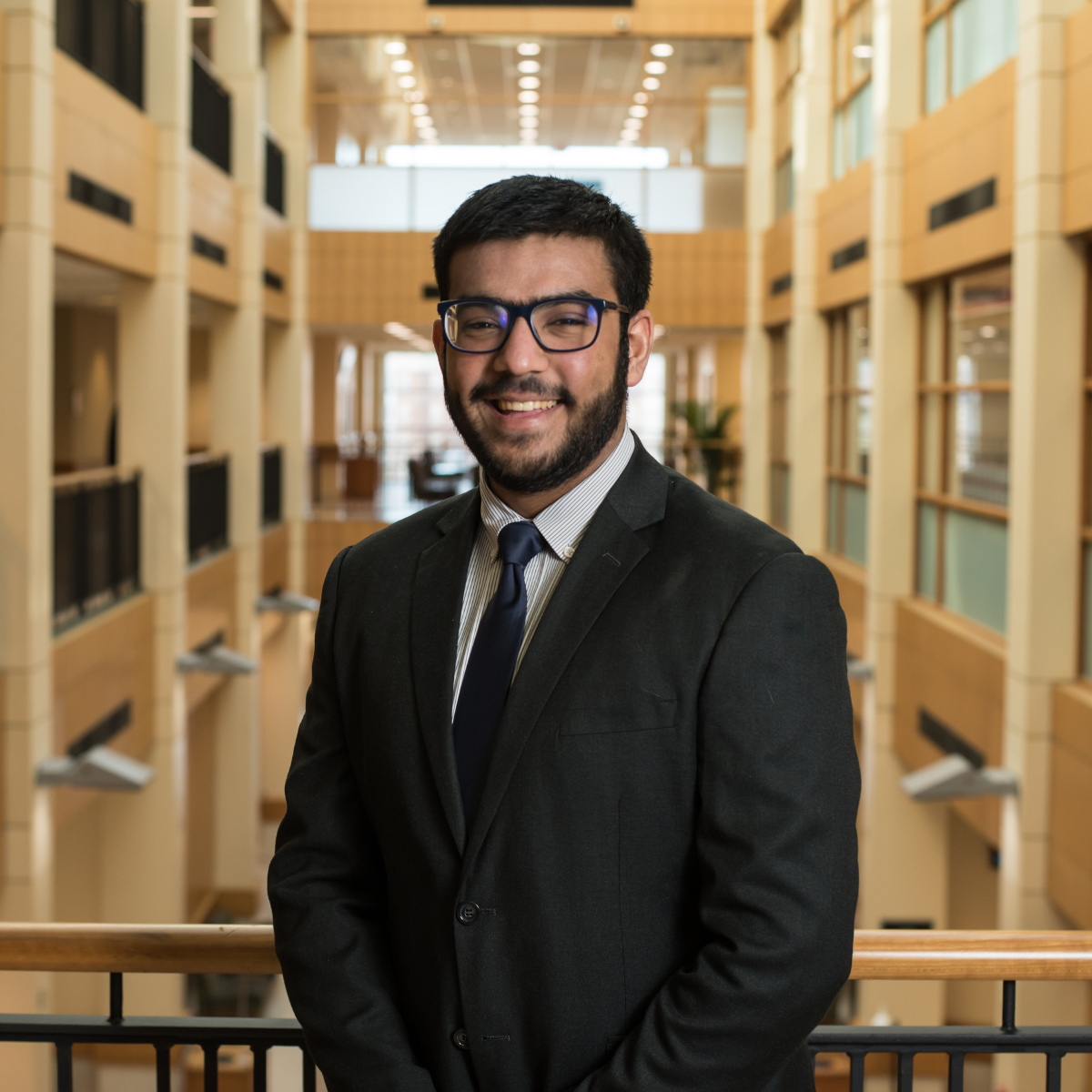
Ayman Bootwala, ESG Equity Associate at Bloomberg
Undergraduate Major(s): Economics & Mathematics
Ayman Bootwala graduated in 2024 with degrees in Economics and Mathematics, and was initially set on a career in investment banking. Outside the classroom, he channeled a different kind of ambition, planning sustainability-focused events for the Center for Social Value Creation, a role that hinted at his future career trajectory.
Like many finance students, Bootwala pursued internships every year of college, starting in corporate finance and moving into investments, where he was first introduced to ESG (Environmental, Social, and Governance), a framework for evaluating a company's sustainability practices, ethical impact, and risk management. Actions such as lowering carbon emissions and implementing safeguards for human rights and labor are positive indicators of a company’s ESG. That exposure led him to a final internship and ultimately a return offer to join Bloomberg as an ESG Equity Research Associate, a path he describes as unexpected, "but ended up being exactly what I was interested in."
In his role, Bootwala researches stock portfolios to support impact investing, helping governments and institutions steer clear of companies with poor environmental or ethically questionable records. Bloomberg's influence in the market means that pulling investments sends a real signal, directly affecting stock prices and, ideally, corporate behavior.
Bootwala believes ESG is only growing in importance. He foresees it shifting from a niche specialty role into a necessary lens for any finance professional that can also set them apart from the crowd. Companies are becoming a little greener each year, Bootwala remarks, and argues that investing without considering ESG is effectively “missing a piece of the puzzle”.

Alessia Richli, Associate at LittleFoot Ventures
Undergraduate Major(s): Finance
Alessia Richli graduated in 2023 with a degree in Finance and a minor in Sustainability Studies. She began her college career in International Business before switching to Finance, viewing finance as a skill she could apply to whichever issue captured her attention. Eventually, that issue became improving food systems.
In her first year of college, before transferring to UMD, she noticed that students were throwing away a staggering amount of the food served in dining halls—nearly 70%. Having spent years living in Kenya as a child and witnessing food insecurity firsthand, she found the waste startling. Afterwards, sustainability became her focus. She spent a summer interning with a sustainability organization in Germany and later worked as an ESG analyst in Washington, D.C., gaining insight into sustainable business models and the policy and legal dimensions of corporate sustainability reporting.
After graduating, Richli earned a master's degree in International Business and Sustainability from Sciences Po in Paris. She now works at LittleFoot Ventures, where she develops food systems sustainability strategies for companies across the globe, working to reduce waste and improve sustainability at every stage, from production to distribution.
Richli sees sustainability as intrinsic to her value system. She’s especially focused on food, the area she believes deserves the most urgent global attention. As she puts it, “at the end of the day, food touches everyone.”
 Menyae Christopher, Policy Associate at Sol Systems
Undergraduate Major(s): Government and Politics & Germanic Studies
Menyae Christopher graduated in 2016 with a concentration in International Relations, and he spent his time at UMD working at RecWell and interning at the German Marshall Fund of the United States.
His sights were set on international policy, and a fellowship in Berlin allowed Christopher to dive fully into the field. While abroad, he researched Nord Stream 2, the natural gas pipeline connecting Germany and Russia. The experience became his case study for how energy shapes global trade and why affordable energy is necessary to keep domestic prices stable.
This was Christopher’s introduction to bridging his policy background with the world of renewable energy. Today, he works as a Policy Associate at Sol Systems, where he monitors regulatory updates across 38 states and lobbies at the federal and state levels on behalf of solar energy and renewable energy adoption.
Looking back at his undergraduate days, Christopher wishes he had taken classes in sustainability, finance, and economics, the tools needed to balance environmental impact with economic feasibility. He describes sustainability acumen in the energy sector as an absolute benefit to everyone, and as a clear pathway to improve health outcomes, strengthen economies, and reduce climate change. “Energy is only 7% of the American economy,” Christopher says. “But it’s the first 7%, because without energy and electricity, nothing else happens”.
These hardworking and successful alumni are using their varied undergraduate degrees to make impactful contributions to society and the environment, and show that any job can be a climate job. The paths of Ayman, Alessia, and Menyae— a single internship, a dining hall observation, a natural gas pipeline research project— are as different as the majors they chose. Still, their stories reveal a common thread in applying their skills and coursework to issues they care deeply about.
As the demand for sustainability expertise continues to grow across industries, the question is no longer whether or not sustainability is important for every field, but rather whether or not professionals are ready to embrace it. There’s no better time than now for current students to identify how their passions align with sustainability and to start building their own path to bring them together!