
Staying informed about sustainability challenges—both here in Maryland and across the globe—can be overwhelming. Deciding where or how to begin making a difference can also feel daunting, which is why communities often rely on expert guidance to synthesize the evidence and illuminate a clear path forward.
Here at UMD, the University Sustainability Council (the Council) serves as that guiding body. As a campus advisory group, the Council supports the President, the Office of Sustainability, and the broader campus community with integrating sustainable practices into university operations. Beyond supporting initiatives like our Climate Action Plan, a strategic roadmap to reduce greenhouse gas emissions, the Council uses its cross-disciplinary expertise to establish long-term goals that drive campus’s sustainability strategy. These goals take complex challenges like climate change, emerging AI technologies, and human well-being and translate them into actionable focus areas where UMD can make a tangible impact.
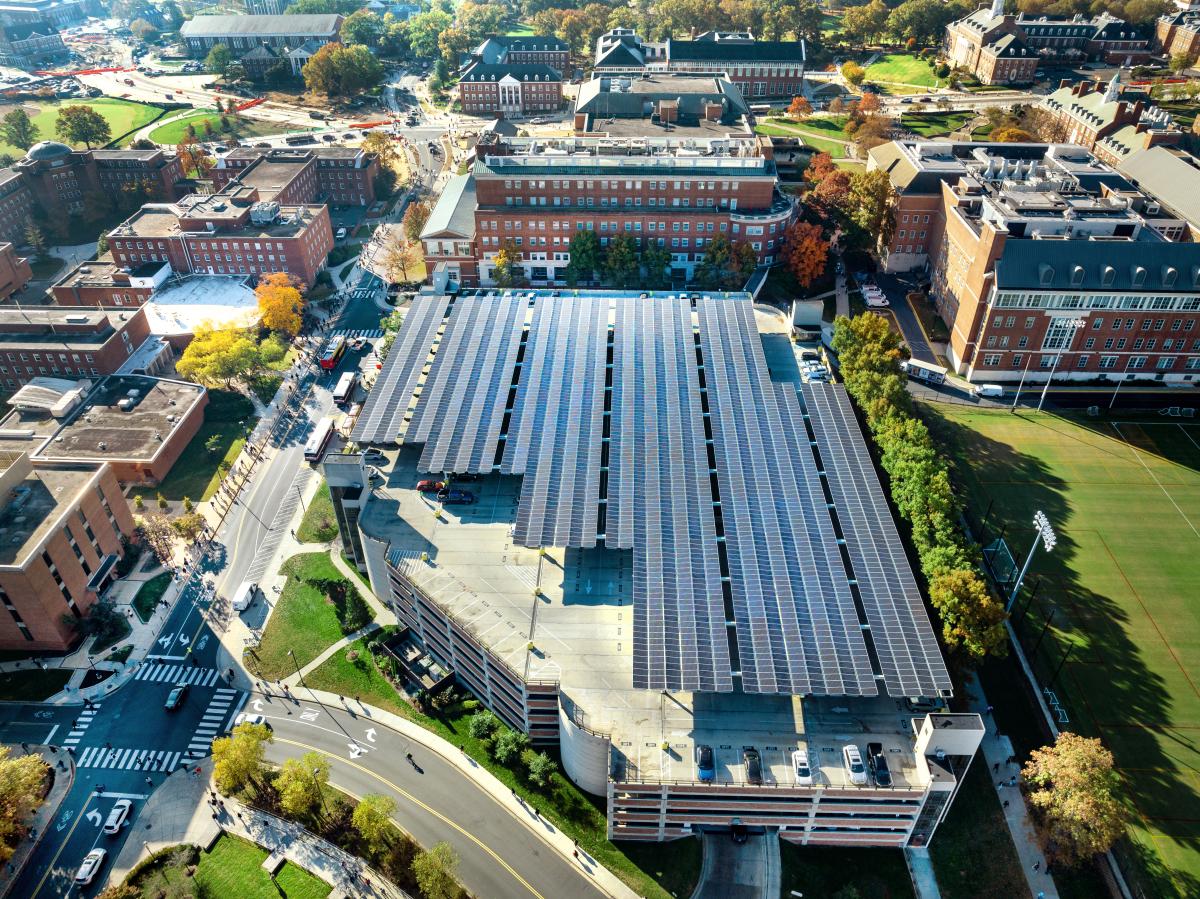
To ensure those focus areas reflect today's realities, the Council reassessed previous goals established in 2014, updating them to align with current climate science, shifting financial landscapes, and evolving cultural norms.
Scott Lupin, Director of the Office of Sustainability, said, “When the Council adopted the 2014 goals, the intent was to set a broad, clear direction for the university that built on existing efforts like the 2008 University Strategic Plan and 2009 Climate Action Plan.” Sally DeLeon, Sustainability Manager in the Office of Sustainability, added, “Sustainability principles were not as much a part of UMD's institutional identity as they are today, so I think we are ready for a more intersectional set of goals now. Between 2014 and 2026, a lot has also changed with regards to the technologies that UMD depends on to power cutting-edge research, as well as the ways that students perceive the linkages between social, environmental, and economic dimensions of sustainability.”
The new goals were developed through an iterative process across the 2025–26 academic year and were published in October 2026. The Council drew on insights from UMD’s 2025 Sustainability Tracking, Assessment & Rating System (STARS) submission and leveraged the expertise of the Council’s faculty, staff, and student representatives to identify and focus on the top issues impacting our campus footprint and community. The Council also reviewed the State of Maryland’s updated Sustainable Growth Policy & Planning Principles and recent United Nations assessments of Sustainable Development Goals progress. To ensure relevance, feasibility, and broad buy-in, the drafted goals were shared with members of the SustainableUMD Network for their review and comment.
Over the years, UMD has achieved many of its foundational environmental benchmarks, such as reducing greenhouse gas emissions by 51% since 2005 and purchasing 100% renewable power since 2020. Having now addressed much of the “low-hanging fruit,” this next phase of action presents more complex and resource-intensive challenges.
“As federal and state funding sources have become more limited, paying for positions to operate and maintain sustainable buildings, electric buses, campus gardens, the Campus Pantry, the Terp to Terp Campus Reuse Store, and other signature programs is becoming more difficult,” says DeLeon. “Transitioning campus energy systems away from fossil fuels will be extremely expensive and will require carefully choreographed, multi-year construction processes. We have enough passion and expertise in the SustainableUMD Network to tackle these complexities, but we need to work together and stay optimistic to do so.”
To navigate these complexities, the updated goals are designed to be ambitious yet directly applicable to Terps’ daily campus experience. Spanning campus operations, research, and education, the seven new goals encourage action at both the institutional and individual levels. They build on past successes in areas like sustainability education and smart growth while introducing new, timely focus areas, such as research operations, hyperlocal ecological awareness, and deeper cross-campus collaboration that helps students prepare for sustainability-minded careers.
While a number of goals will be carried out through key operational initiatives, many will rely on the everyday choices of students, staff, and faculty. Whether it’s staff sorting waste in office breakrooms or students connecting with faculty to join a research lab, small decisions that directly conserve resources, spark curiosity, or connect the campus community with tools for success will all contribute to collective progress.
Below are the seven goals that will guide the Sustainability Council and the Office of Sustainability through 2036.
- Sustainability Research & Scholarship: Support an integrated network of interdisciplinary, sustainability research and scholarship that helps inform campus sustainability-related decision making and contributes to Maryland's biodiversity and conservation goals
- Culture of Sustainability in Research Operations: Further understand and manage environmental and social impacts of UMD’s technology and innovation ecosystems
- Community Partnership for Impact: Prioritize connection and reciprocity in sustainability work with Maryland Communities
- Food Resiliency, Access, & Education: Advance a resilient, equitable, and sustainable campus food system that increases access to nutritious food, strengthens regional partnerships, and reduces environmental impact
- Experiential Learning: Support faculty, students and staff to implement and engage in project-based learning and other types of learning experiences with problem solving and innovation to solve sustainability challenges
- Sustainable Infrastructure & Campus Growth: Position the university as a living model of sustainable urban systems and exemplify leadership on the State’s regulatory targets and sustainability goals
- Ecoregional Wisdom: Cultivate opportunities for people to identify with and relate to the ecology, culture, bioregional aspects, and local ecological knowledge that contribute to a sense of place that is Maryland